22 July, 2019

Permabee plans (iteration 1)

Move water tank
a. prereq: chop down bush
b. prereq: set down frame to hold gravel (sleepers)
c. prereq: gravel into frame
d. buy: short metal stakes for framework, ~1m cube gravel

undo biocompost & remake
a. empty biocompost
b. reset frame
c. chip the chips to make them smaller
d. remake biocompost
e. get: coffee grounds, horse manures, grass clippings from neighbours, café wastes; mix it all in. (ask for: comfrey and other micronutrient plants)

plan(t) out front food forest/fence
a. macadamias and acerola cherry
b. elder | loquat | mulberry | black sapote | avocado
c. citruses (? bad time in winter – leave until Oct-Nov and plant down at the edges of flame tree once jacaranda is gone?)
d. underplanting with borage, vietnamese basil, comfrey, sprinkle with floral seeds in between

plan(t) out banana circle
a. not actually a circle, but certainly a grouping:
b. bananas, mango, pawpaw, black sapote, lychee, avocade
c. ginger, galangal, turmeric,

08 July, 2019

maps and plans

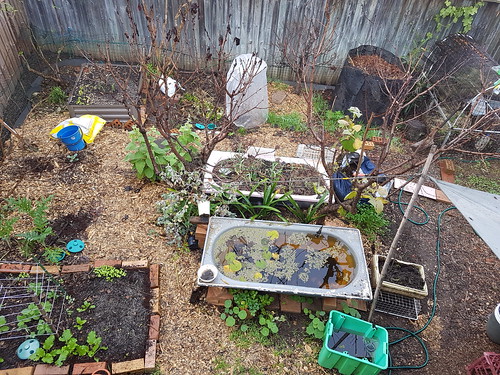
A layout for the garden before I had chickens:

Garden winter 2019

And the garden on the weekend. Easier to see because it's winter and there are no leaves.

Garden winter 2019

Useful to see, isn't it?

26 June, 2019

food forest links

Gallifey Permaculture: what works for them - AU

Permaculture Apprentice: Creating A Food Forest Step By Step Guide

My Smart Garden: Creating A Food Forest - AU

Shrub layer:
Tree Lucerne (Tagasaste)
Acacia Cognata (cousin It)
wormwood,
southernwood,
rosemary,
lavender,
hyssop,
lemon verbena,
citronella,
scented geraniums,
tansy and
other shrub sized daisies and
mountain marigold

ABC Fact Sheet: planning your foodforest

24 June, 2019

Food Forest

Right, so it might very well be time to panic now.

I have a LOT of trees. And not much space. And I feel like any design that I undertake will be half-assed at best.

I went through the trees and am wondering if I should plant the citrus (lemon, kaffir lime, kumquat) right up against the fence. Put the pomegranate in with the fig on the triangle garden.

Part of the problem is that I have so many trees that are listed as 'delicate' and 'don't like cold winds" which I'm thinking, right in the middle of winter, is a pretty tricky thing.

The current count:
3 citrus (lemon, k lime, kumquat)
1 acerola cherry
2 macadamia
1 pomegranate (to go with the fig, I think)
2 avocados (grafted)
1 avocado (from seed)
1 chocolate pudding tree (sapote?)
1 almond/peach (from seed)
1 elder tree

I have a loquat, but I'm thinking of not planting it anymore. There used to be a loquat at the corner of the next street, but they chopped it down and have planted a nice, sedate hedge, probably of lilly pillies. At least that's one thing that I won't have to plant around here. Besides, loquat are kind of monstrous, and I'd rather a lychee tree.

There's root systems to consider. How tall they're going to grow. Shade considerations. And nutrient requirements.

The almond/peach has a deep root system. The citrus, avos, and elder have shallow systems.

There's also the issue of there being a stormwater pipe that runs parallel to the street across our property. You can tell where it is because it leaks a little - the grass over that pipe grows more thickly - it was much more noticeable during the dry summer. I can't plant anything with deep roots close to that or they'll just take it over and then the council will have to come in and dig up the space. So, nope.

Citrus like a lot of feeding. So do Avos. Pomegranates and figs survive just about anywhere, but would probably produce best in hotter drier conditions. Acerola cherry likes acidic soil (like blueberries), and macadamias have developed in poor soil and dry conditions. (I'm thinking about on the council verge.)

3 citrus up against the fence
1 acerola cherry with bluebs underneath
2 macadamia on the council verge
1 pomegranate in the triangle orchard with the fic
2 avocados (grafted)
1 avocado (from seed)
1 chocolate pudding tree (sapote?)
1 almond/peach planted at the end of the row
1 elder tree

Also, I tink I need more shrubs and bushes. Chickpeas? I have pigeon pea seeds. Also some herbs that smell nice and attract bees. I have flower seeds - sweet peas and suchlike, but those are annuals. I want some perennials.

11 June, 2019

Summer to Autumn to Winter

In February the chooks were moved to the Crepe-Apricot bed. They've been there for four months, and I've been adding not only kitchen wastes, but also garden wastes, woodchips, fallen autumn leaves, and some bits and pieces of other things to the tractor, so they've had a good chance to break it all down. The plan is to move the chooks on in the next week or so - probably onto the Avo-Shed again - put a border on the Crepe-Apricot bed (bricks again) and then leave it to mulch for a couple of weeks before planting out.

Current chook tractor location is the Crepe-Apricot bed:
Garden winter 2019
All that leaf litter I'll leave to sit for a few weeks more and then plant it out. Planting out" for this bed requires planting more seeds of broccoli, mini cabbages, caulis, silverbeet, and anything else I can persuade to grow in there.

Onions, carrots, and parsnips are being grown in very fine soil. Radishes and beetroot and garlic have also been sown in a raised garden bed I put over the chook tractor bed base. I forgot to take a picture of it, though, but the radishes and garlic have both sprouted, although the carrots and parsnips aren't showing yet. Hopefully hopefully...

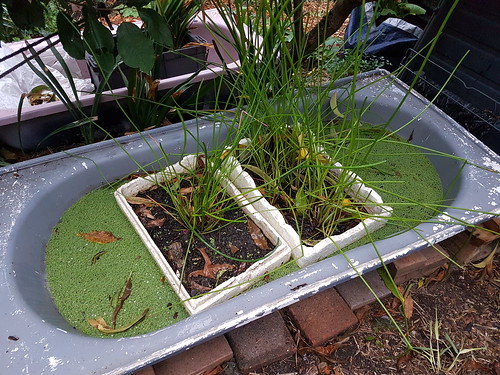
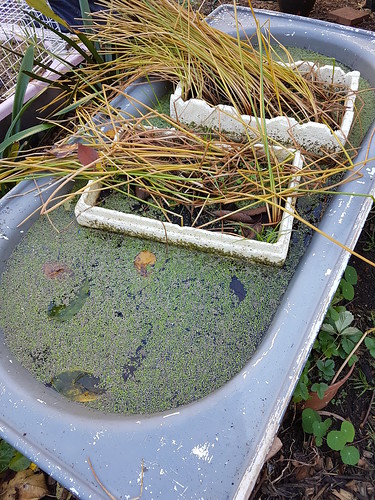
The azolla is growing great guns, and has been excellent for feeding to the chooks, making compost, and keeping mosquitoes from breeding in the water.

At the height of summer:
Garden February 2019

And now (after several 'harvests' for composts and chook food) it's dying down in autumn (as azolla does):
Garden winter 2019
The stuff grows back so fast I can't stop it. And I haven't had trouble with mosquitoes since the end of February.

ASPARAGUS!
Various February 2019
I can't tell you how excited I am about the asparagus this year! I mean, it's long since been exhausted, and definitely needs further mulching, and pretty soon, too, I think - before we start getting frosts. Which we're hovering on the edge of right now.

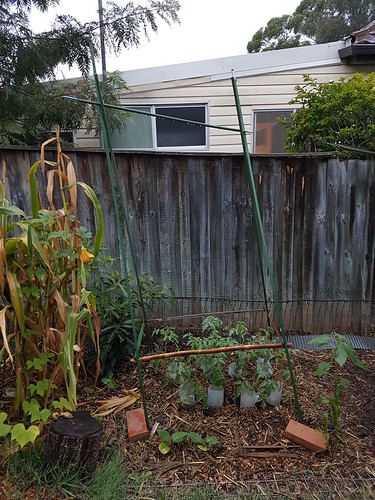
Avo-Shed bed - has been growing tomatoes all summer, eggplants and sunflowers a little, and pumpkins/curcubits NOT AT ALL.
Garden February 2019
The chickens are going on that bed next, and will probably be there until August.

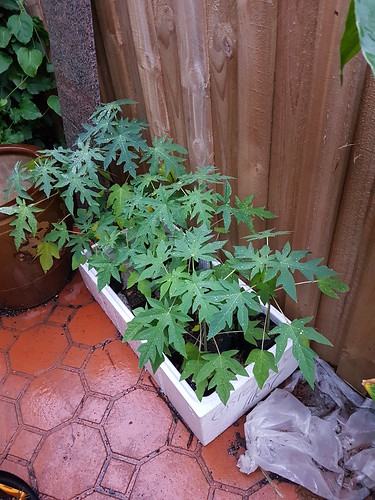
I managed to grow a whole slew of papaya seedlings:
Garden February 2019
Gave a bunch away, then a whole heap of them got waterlogged and about half died. I have maybe four or five left and I don't know how well they'll do. They'll be going into the banana circle...if I can get them to keep growing!

Speaking of the banana circle, there's a lot to go into and around it: bananas, turmeric, ginger, galangal, taro, mango, paw paw, pineapple, comfrey, lemongrass...

Don't even talk to me about the 'food forest'.

I also considered the best location for sweet peas and have decided that it would be best utilised beneath the front window, where we have been trying to grow raspberries (they burn in summer) and where the rosebush has been doing utterly splendidly. They should be fine there up until spring, at which point, they might burn some...

I really need to take to that rosebush with a chainsaw, because I don't see how else I'm going to get it properly cut back. Plus, I think the trunk has some kind of scale on it.

I do need somewhere in the back to put clumps of flowers - at this stage, the best option would appear to be in front of the apricot, or else running alongside the bathtub gardens. I wonder if I could get poppies to grow?

Flowers for Spring
Poppies, wildflowers, etc. in one of the square cement pots.
Tulips in the green pot on the front porch.
More bulbs the square cement pot by the back door.

So many thing to do; so little time...

10 June, 2019

notes on Back to Eden, woodchips, and composting

"Woodchips" are not the chipped wood pieces that I assume they are.

"Woodchips" as described by the guy on Back to Eden are actually composted material comprised of both chipped wood logs and leafy mulch.

So I piled the woodchips up in a windrow by the fence, unfortunately no chance to add water or coffee grounds... I think I'll probably end up having to add them in compost tea over the coming weeks

Contemplating compost: maybe I should turn the compost bays tomorrow?

Growing potatoes and improving the soil
- autumn leaves and coffee grounds (sprinkled) about 6 inches
- plant the potatoes in a hole in the leaves/grounds surrounded by some handfuls of vermicompost with worms
- cover up, sprinkle coffee grounds, cover with more leaves/grounds, water
- when potatoes grow up about 6-12 inches above the soil, mulch again with leaves/grounds

I need a bed in which to put the potatoes; I don't have one. Either need to make something (metal rebar stakes and low wire edges?) or else buy/swap a garden bed...

Hm. What if I levered the two pallets apart and used the wood in those? Dig the posts in, put down lots of newspaper and shredded paper in the base to block off the weeds, then start layering the leaves and the coffee grounds...

08 June, 2019

Subpod observation

The Subpod (Australian designed/made) is pretty neat. It's a box you sink into a garden bed, holes in the sides and bottom, with composting worms inside. You put your kitchen scraps in the box, and the worms turn it into vermicompost (worm castings). You've got a hinged lid and can put a wooden top on, so it can be

But at $130 AUD, the practical side of me says: you could do this with a worm farm box in your garden. Just drill a few extra holes in the sides of the box and sink it into a garden bed and it'll do the same thing, only less slickly. And you'd have to make your own cover, but that's not so hard, I think.

--

I just bought another HenSafe door for the triangle coop which will be the house for the girls for a portion of the next month. The intention is to put them in the front garden and just leave them there day and night, with the netting fencing to keep them in.