Showing posts with label learning. Show all posts

30 November, 2021

busy fortnight: fruit tree assessment

All the harvest processing, all the canning, all the mess and exhaustion and time taken...

Harvest November

And there's still some yet to go - although the main processing is the early nectarine and early peaches.

Overall in the fruit harvest:

1. Dual Stone (white peach and white nectarine): very heavy crop, lost about a third of it to mould and possums. That's usual. The nectarines are sweet as ever. The peaches are *meh*. Nectarines harvested in the first couple of weeks of Nov. Peaches harvested in last couple of weeks of Nov.

Such a delicious nectarine!

Harvest November

2. Two Stone (golden peach and white nectarine): lost most of the nectarine to mould. Still harvesting the golden peaches. Nectarines harvested in second week of Nov. Golden peaches harvested last week in November through to early Dec.

3. Quad stone in backyard: nectarines were ready in 2nd week Nov, but mostly lost to possums and mould. Apricots in 3rd week Nov - only two harvested. Plums ripening early December and a solid crop, no fruit fly. Donut peaches won't be for a number of months yet.
4. Cherry: 4 cherries, ripened in last weeks of Nov. *sigh*

Harvest November

5. Apricot: 2 apricots, still ripening in late Nov.

6. Dual Plum: about 5-6 plums, mostly on the mariposa side (probably), no sign of fruit fly.

7. Donut peach: not expected to ripen until later in the season.

8. Back avo: a couple of avos, lots of leaves. Trimming it down now.

9. Four apple: a few apples on the left branch, ripening. One or two apples on the right branch, ripening. Tried a few that fell down early - floury. They'll go into an apple-rhubarb crumble.

10. Hedge apples: harvested a couple from the early graft, but rather floury right now. Might not be ready yet? Or fell off because not ready? Otherwise, they're all small and growing.

11. Gala-Braeburn: Braeburn graft still growing pretty well, no sign of fruit fly or codling moth (would have to cut open an apple to find out)

12. Blueberries: doing okay by the fence, but haven't harvested any yet (must go look at them)

13. Mango: has a few fruit, not sure if they'll survive any longer than this

And yesterday I harvested a bunch of carrots - thinned out one of the beds to make space for others. It's a pretty good rainbow from this mix.

Harvest November

Regarding the fruit trees, I'm going to massively trim them down this year. Front and back, both. They're just getting out of hand so far as overproducing fruit is going. Also, I really rather wish that they were spread out across the summer better. My bad for not getting early and late varieties, accidental or no.

14 April, 2020

Chooken-keeping Resource List

Jackie French's Chook Book
Yes, this is 'Diary of a Wombat' Jackie French. Her Chook Book is helpful about principles and methods for those of us who still like a good hold-in-your-hand resource to read through.

Jackie French's Backyard Self-Sufficiency
She has a whole section on 'small barnyard animals' in which chickens are briefly mentioned. But the whole book is a good introduction to planting and eating more from your own garden.

Linda Woodrow's Permaculture Kitchen Garden
The author who first made me realise that I could keep chickens in the garden and how to make the 'downsides' of chickens an 'upside' for the garden. The downside is that she focuses on the method she uses in the garden, not the principles. That said, the concept of using chickens as not just egg-layers but as mulch-makers, manure, food scrap processing, insect and pest control, and garden clean-up was revolutionary to me, and broaded my perspectives in so many ways. The book is some twenty to thirty years old, but the concepts are very relevant all the same.

Chooken Keeping 1

The Google.
Yes, you get a lot of results, but you can refine searches. I'm in suburban Australia, so I prioritise those who live in other parts of urban and suburban Australia. Good for general information about things before you get down to the specific. Also, lots of videos from people (mostly homesteaders) who have ideas about chicken coops or advice on how to integrate chickens.

Special mention to Self Sufficient Me whose video on chicken bullying I just watched as advice on how to integrate our two new chickens (the New Shanghai) with the old ones (Original Recipe).

Pinterest
Yes, it's full of pretty pictures and glorified stories of happy clappy chooks and their perfect pristine pens. But there are some gems in there, if you're willing to read up. All knowledge is worth having.

Local gardening groups.
I'm the current president of Permaculture Sydney North, and an active member of Crop Swap Sydney/ My garden was in the Virtual Sydney Edible Garden Trail this year. These are all local groups to me, and important knowledge networks - people who have done this before, or who are having the same problems, or who might have solutions to your problems that you haven't thought of yet.

Facebook Groups
There is almost certainly a group for your locality or area.

Mine are:

A small matter of courtesy
Join a local group, by all means. But please don't just barge in and ask your question. Start with a search - for Facebook there should be a search box either at the side of your screen (desktop) or along the top of your screen (mobile app). Chances are, other people have asked the question before and received many helpful answers. Read through them all, look at the arguments and think about how they do or don't apply to you. Sometimes it helps to ask a similar or related question on the same post, so whoever comes along afterwards can find all their answers in the once place.

21 March, 2020

Planting in a time of coronavirus

PANIC! AT THE SUPERMARKET!

We've all seen the empty shelves. Mostly drygoods, but also some things run out faster than others. It kicks off something in our brains and a part of us goes into 'worry mode'. The comforts of our existence rest on a very narrow edge of 'normality' and if that 'normality' falls through, what then? How do we ensure food security?

Now, let's be honest. Very few people are going to be capable of producing as much food as they and their family need to survive. Remember the feudalist concept of peasantry? It took a peasant all day, every day, year in, year out, to provide enough food for themselves and their overlords. Granted, some of that might have been because their overlords were nasty pieces of work, but some of it was because working the soil is HARD. The curse of Adam in Genesis 3 is that Adam will work the soil and it will be labourious and difficult. And even farmers - who work off the economies of scale and the advantages of machinery, GMO, and pesticides - can tell you that working the land is no picnic today.

That doesn't mean you shouldn't grow anything. Don't be so absolutist! A little bit here and a little bit there, and you will appreciate both what it takes to put that perfect green lettuce, those round red tomatoes, those huge fragrant onions, and that big moist avocado into your salad, as well as that we have this kind of food to excess in our societies.

But where do you start?

1. start with what you already eat

If you don't eat zucchini, don't plant a dozen plants. If you hate tomatoes, don't sow tomato seeds! If you dislike kale don't think you're going to love it just because you grow it! Start with the vegies that you're already eating.

I mean, you're probably screwed if all you eat is, say, apples. You need low-chill ones in Sydney and the right microclimate can certainly help, but it's a bit more effort than you should probably start with.

2. pick the vegies that are easiest to grow

Salad greens, Asian stir-fry greens, spinaches and swiss chard and mustard leaves, sweet potato vines (mostly for the leaves with bonus tubers). All of them just need a good steady water source which you can probably give them even in hot, dry weather from the water that you use to rinse your vegies, or the warm-up water caught in a bucket from your shower, or the runoff from your roof.

We're living on the 2nd driest continent on Earth (but the 1st is Antarctica, which is honestly a category all its own) so we need to be more circumspect with water usage and wastage. And growing food requires steady watering. You need to work out where that water is coming from.

3. pick vegies that are bad value for money when you buy them in the shops

Herbs. ALL THE HERBS. Because unless you're making pesto, half the time you only want a few sprigs of it. Rosemary, coriander, basil, thyme, parsley, sage. Coriander and basil are annuals - they need re-seeding every year, but the others are pretty much perennials that will grow back and grow back and grow back. Have a permanent part of the garden that's dedicated to herbs, and then sow the annuals (lettuces, Asian greens, etc) between them.

4. Try growing 'perennials' - re-seasonal plants

Perennials are ones that keep growing back season after season. See the herbs section above - rosemary, sage, thyme, parsley. There are perennial spinaches, and some kales and lettuces can be grown perennially so long as they are kept watered. Believe it or not you can grow garlic as a perennial - just so long as you don't mind the garlic being the leafy greens rather than the white bulb (they still taste pretty much the same).

But what should I grow RIGHT NOW in March 2020 with social separation looming and a desire to build a garden?

If you're in Sydney, it's the perfect time to grow any of the following:
spring onions
lettuces, spinaches, rocket
Asian greens
swiss chard/silverbeet
radishes
peas
broad beans
brassicas (broccoli, cabbage, cauliflowers, brussel sprouts)

For spring onions to radishes, the soil doesn't have to be fantastic. Just sow in rows and keep watered - particularly the leafy greens.

For peas and broad beans, the soil doesn't have to be particularly rich, although it helps if you want a crop.

For brassicas, they're hungry beasts; not as hungry as corn, maybe, but they still like a good feeding.

But in all seriousness, just get a pot and start growing things. The sooner you start, the sooner you'll get a crop. And right now, we can all do with a crop...

30 October, 2019

various videos

Many videos for watching later

Self-watering raised bed construction

Wicking beds - Sustainable Gardening Australia Footprint Flicks

How to make a wicking bed container food garden for Randwick

Self-Watering wicking bed
verdict: pretty useful.

Wicking Pots

Wicking bed how to.. A self watering garden bed: close

Self-watering planter: relevant because this is probably close to what I want to do.

Hugelkulture Pots
(too long-winded)

Hugelculture: In A Pot! (nursery trick)

How to build and install underground watering system

DIY Underground Watering System

Annual Backyard Hugelkultur Maintenance & Planting Out The Beds
Pretty good, lots of tips and ideas --

Why Crop Rotation is a waste of time
Interesting argument.

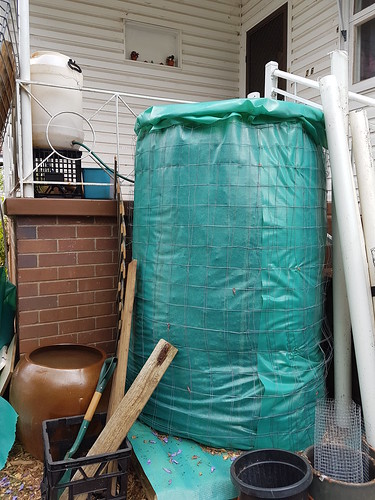
the Johnson-Su compost bioreactor

Iteration One - February 2019

The first iteration of the Johnson-Su compost bioreactor was made in December 2018, during a permabee at my house

Bioreactor

There were a few variations in the way we built this:

1. The wire was thinner than it was in the video - maybe 4-gauge, while the video wire was about 6-gauge or something?

2. The plastic was green and translucent rather than black, which may have made a difference to the bio-organisms that are supposed to be occupying the compost: they may not like the light, so the outside may end up not quite as well-processed as the inside.

3. The woodchips were actual woodchips, minimum 2.5cm (1 inch) and many were rather larger.

Otherwise we built the compost bioreactor according to the specifications in this video and left it be.

I don't think there was quite enough nitrogen materials for the bioreactor, because it didn't heat up at all. I had to add coffee and horseshit to the top of it and it's not really soaked all the way through. Next time, I'll spend a couple of weeks building up the nitrogenous materials: coffee, lawn clippings, horseshit, vege refuse from the local greengrocer...

Anyway, the compost didn't hot-decompose at the start, but so far as I can tell from turning it over, it's still decomposing fairly well with a regular application of runoff wash water (sometimes mixed with human urine). It's only been 3 months, though, so it's difficult to be sure - I think you're supposed to leave it for 5-6 months at least.


Iteration Two - July 2019

I'm writing this in October 2019, 2 months ago after I had another permabee, during which we took apart the Johnson-Su bioreactor.

Permabee 2019

There was some decomposed material, but not the entirety of the bioreactor as expected from the video. The compost was filled with undecomposed woodchips. This was disappointing to say the least.

So we sifted some of the composted matter out and rebuilt the bioreactor, chipping up the larger pieces of wood and branch the better to decompose.

It seems to be decomposing a little faster than last time; it's been two months and it has a fairly significant slump to it, which suggests it's processing. The 'lid' has blown off - we've had some strong winds in late winter and early spring, and when it rains (as it occasionally does here) the lid fills with water that then needs to be redirected either back into the compost or into the garden.

The wooden pallet beneath the biocomposter has collapsed. It held up for the first biocompost, and then through the making of the second, but it's given up the ghost, and the biocompost is leaning rather heavily. The plastic underneath the biocomposter is very necessary to keep the pallet from rotting since the materials are being regularly dampened.

Speaking of which, a bucket a day into the water reservoir over the biocomposter, seeping down through the tubing that I put there, seems to be working pretty well. It's a manual labour that's a little frustrating, but not terrible now that spring is in and it's not freezing cold outside in the mornings.

I have recently added some 'duck straw' - straw that has been used for keeping ducks - whole and unchopped, and now I'm regretting that, just a little. I should have run it over with the mower a few times and worked from there.


several thoughts

The first video didn't really specify the size of the woodchips - it just said 'woodchips' which I've since discovered means something else in the USA to what it means here in Australia (Wood Chip Gardening: What I Wish I Knew When I First Started). The second video by Johnson on filling the bioreactor specified the size - 3/4 inch (1.75cm) size - and noted that he pretty much chopped up the leaves using either a leaf mulcher or a lawnmower.

The size of the pieces in the biocomposter is going to make a big difference, I feel. As with any compost, when you're making it, you want things to be damp and chopped up into small pieces.


Going forward

At this point, I'm not sure that making it a third time would be terribly helpful: while the plastic is still okay to go, the wire is falling apart and probably best suited as a climbing frame for something light - beans or peas, perhaps. Also, the pallet underneath would need replacing. I guess it's a different kind of compost to the hot compost in the composting bays, or the stuff that I make in the black geobins.

Ultimately, the value of the biocompost is in the high volume of microbial-organisms that take up residence in the decomposing compost due to not being regularly turned the way a 'hot' compost would be turned. Also, not having to turn the compost - a big attractant given how many composts I have that require regular turning over!


I probably wouldn't want to make it more than once a year; let it sit for six months, gather up the materials for the other six months, breaking them down, then making the compost and letting it sit.

Hm. I'm also wondering if I could make the biocompost using a geobin structure for the framework.

13 August, 2019

how do you like them apples?

Quite a lot, actually!

On Saturday I went to the garden of one of the women at my Permaculture Gardening Group who was going to take us through Pruning, Air-Layering, and Grafting.

Pruning and orchards

The part I was really interested in was the part where she offered scions of her apple trees. She has FOURTEEN kinds of apples in a suburban garden, most of them grafted on individuals trees. It was AMAZING and I came away quite inspired in several dimensions.

Pruning and orchards

I did have about six apple types before I got a bunch of her scions. Four arrived already grafted on a single rootstock: Anna, Granny Smith, Golden Dorset, and a mystery apple (I lost the tag that indicated what type it was, but it might have been a Jonathan?). And two were individual trees from my mother: a Golden Delicious and a Gala.

I got about nine apple scions from her: Akane, Adre Sauvage, Blenheim Oragne, Tropic Sweet, Tropic Dorsett, Tropic Anna, Egremont Russelt, Kid's Orange Red, and Yates.

I have two more apples coming: a Pink Lady with a Braeburn grafted to it. The Braeburn is because my sister loves them, but they don't grow them commercially this far north because the climate doesn't support it - Braeburns are cold-weather trees.

So, yes, we should be covered for apples through the season. Assuming I can get a harvest from them.

And, more importantly, that I can successfully get the grafts to take...

Right now, I'm thinking of which ones I should graft together - cross-pollination requires multiple cultivars flowering around the same time.

Having looked up various apple types, I'm reasonably sure there are maybe 4 pollination groups:
P1: Anna & Golden Dorset
P2: Tropic Sweet, Tropic Dorsett, Tropic Anna, Egremenot Russet.
P3: Akane, Andre Sauvage, Blenheim Orange, Kidd's Orange Red, Yates, Granny Smith, and Golden Delicious, Pink Lady
P4: Gala & Braeburn.

The strikeouts are already on the one tree, along with the mystery apple, which is most likely in a similar pollination group. I could add to the existing multi-apple, I suppose but more than four is probably pushing it, and there are other rootstocks available.

So, probably a mix of P2, P3, and P4 on the Golden Delicious and the Gala and the Pink Lady:
Golden Delicious: Tropic Sweet, Tropic Anna, Blenheim Orange
Gala: Akane, Andre Sauvage, Tropic Dorsett, Yates,
Pink Lady: Braeburn, Gala, Egremont Russet, Kidd's Orange Red

I think some of it will very much depend on what takes. It could be a bit of a hit and miss.

The pruning unit was educational too. I've been pruning my apples like my stone fruit and...that's not the way to do it apparently... But the multi-apple has a few blossoms - at least one of the branches appears to be a tip-bearer rather than a spur-bearer, which might explain why I haven't really had any fruit from it at all! I've been pruning it back and probably pruned off all the fruit-bearing shoots! and then there's nothing left to enable cross-pollination...

Ah well, we garden and learn. I just wish I'd learned a bit earlier.

a bunch of apple-growing links

University of Mass: Spindle Pruning Apple Trees (video)

Fruit Grower’s News: Tall Spindle Design for apples - I’m still trying to find a proper/definitive description of spindle systems and how to prune trees into that shape.

Kimmel Orchard: Tuesdays With Tyler high density orchard plantings - there’s a whole series about orchard care in here.

How to prune apple trees in winter: summer for fruiting and growth, winter for vigour.

I’m also going to need to read up on apricots soon. I’d like one really good harvest out of the backyard apricot before it gives way to probable gummosis. *sadface*

14 September, 2018

bees, natural beekeeping, convenience, and humanocentricism

Read assorted articles about The Flow Hive, mostly out of curiosity. And, more recently, Australian Story, which did a segment on the guys who came up with the Flow Hive. If I may borrow something from the world of body health, the Flow Hive vs. the Langstroth Hive (traditional beekeeping) is the difference between getting gastric surgery for health reason, and just living with your bodily situation.

I mean, Gastric band surgery to adjust eating habits and improve is better than just going on as you've done, but it's not as ideal as, say, losing that weight slowly, over a matter of weeks, months, years. Surgery may be a solution, but it doesn't have to change your lifestyle, and it's best for your body if you can eat healthy and live healthy, lose that weight gradually.

In part, this is because of the difference in mindset; there's a problem - but the problem isn't obesity. Obesity is the symptom. The problem is a raft of other factors that cause obesity: factors that include environment, social and financial limitations, and genetics.

The flow hive is gastric surgery - better than a langstroth hive. But it doesn't necessarily change the mindset of that kind of beekeeping, which is people-centric. The primary consideration is the convenience of the honey harvest, not the way that bees work and humans working with bees to encourage them and - secondarily - to get a bit of honey out of it.

That's the issue that's being argued about the flow hive; that it doesn't really make life better for the bees - we're just making it easier for people. Which, yes, is fair enough if you're keeping bees for honey; although not so much of a good thing if you're subscribing to, say, permaculture or growth abundance principles, where humans maximise output by working with nature, rather than forcing nature to do things in a way that's just simpler on humans, as both Langstroth and Flow hives do.

There are also native bees and their hives, which are a different thing entirely from the European bees...

It's a thought.

31 August, 2018

out of winter and into spring

First day of (calendar) spring tomorrow!

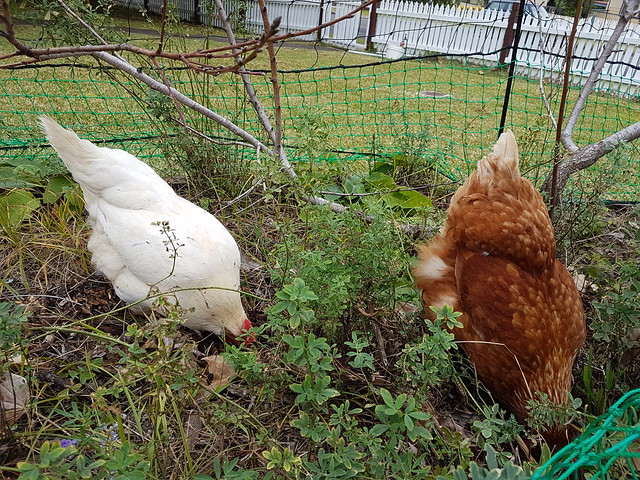
I love how chickens can be used as weeding labour.

My mother was advising me that I had to weed the front garden bed where I have the fruit trees if I wanted to have a good orchard come spring. I hate weeding that front bed. It's full of nut grass, and things with crazy roots, and it's a losing battle for a human gardener.

Enter the chooks, stage left:

Chooks in the front.

I put up a fence around the garden bed, and would move them into the 'yard' (manually, by hand - inconvenient, but necessary since they couldn't be trusted to make their own way there) for a day's scratching and pooping, after they'd laid their eggs for the day. They loved it. Green things to peck at! Holes to dig! Mulch to disperse! HAPPY HAPPY CHOOK CHOOK!

About a month later, mum was around again.
Mum: "Oh, your front garden bed looks really good - did you weed it?"
Me: [ahahahahaha] "No, that was the chooks." After the chooks are gone, this is the garden bed:

Garden end of August

Thoroughly weeded, turned over, composted (chicken poop and vegetable scraps thrown to them), and (with the addition of woodchips and oaten hay) mulched! The still-green sprouts are deep-rooted lucerne plants (nitrogen fixers), and I think I might need to sow a few more of them along the driveway edge this summer. They were excellent mulch harvest last summer, and the chooks trimmed them down during the winter, ready for the spring comeback.

So the front garden bed/orchard is fully weeded and mulched, the chooks had a lot more fun doing it, eating insects, worms, and greens besides, and we got eggs. BARGAIN.

Spring Plans 2018

The garden at the end of June:

Garden winter 2018

I've decided there's no point in trying to make things grow when there's just not enough sun for them. So next year I'll move the chickens through the backyard in the autumn/winter, and sow green mulch everywhere before planting brassicas in the middle of them. I suspect that the plants I grow in the backyard in winter will need some 'shelter' - and a green mulch growing around them is more likely to provide that.

Spring Things

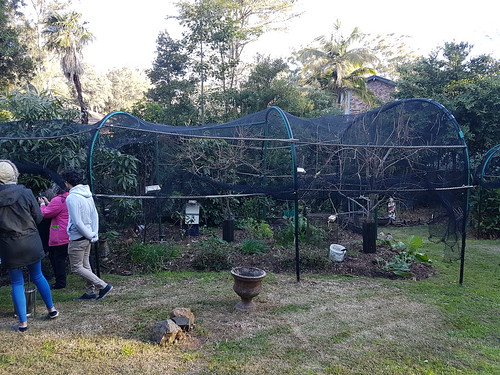
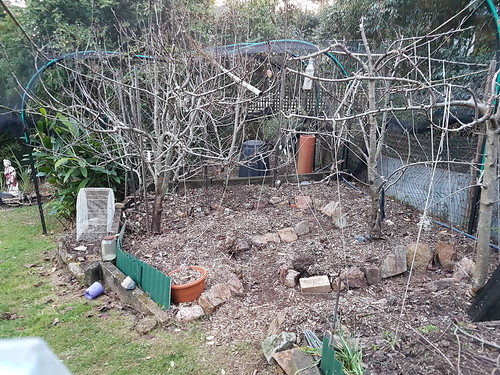
1. Net the fruit trees: dual stonefruit, bi stonefruit, multistone, donut peach (maybe others if we have the netting)

2. Plant out seedlings for midsummer: anything that will grow in the front bed.
zucchini plants along the front/edge
corn in the middle - both seedlings and seeds - plant with a double-handful of worm-castings and compost
pea seedlings around the apple trees (one type of pea)
pea seedlings around the fuyu (another type of pea)

3. Prep the ground for later plantings
west lounge room wall - north of rosebush for raspberry canes
west lounge room wall - south of rosebush for trombocino, melons, luffa (to grow out across the lawn, or up and over the front porch stair railing)
- make a 'border/edge' for the rosebush bed
- trim the rosebush down
- dig out the bulbs and move them?

4. Prep seedlings for later planting
tomatillos and tomatoes: repot seedlings up to the first leaves

5. Calculate what will be needed for the permabee in December
- chicken wire for tunnels, wood/aluminium framing for the edges
- wood framing for composting bays (how long, how many, need wide-and-thin panels)
- wood framing/bricks for bathtub pond (where's it going to go, make a wire frame for it, fill it with pebbles, settle the bath in it?)

6. Move parental plants (discuss with B1)

16 October, 2017

chooks in the garden

One step closer to chooks in the garden! They’re being delivered on Thursday morning, which means I need to work out where they’re going to go to start the rotation. (and, perhaps, to deal with the fruit flies and slugs!)

I have some planned-out chook stations, which I think will need to be better considered once the coop is actually in the garden and I have the size and scope of it all. In a circumstance that slightly complicates things, I planted out one of the beds on the weekends, and the growing period is nearly upon us (from Saturday for 10 days). It’s also the bed that has the most slugs in it, thanks to the leaf litter that I dumped on it a week ago.

The plus side of parentals moving: they’re not going to need all the mulch they’ve been making for the last couple of years. And I am going to be quite shameless about co-opting it for my garden, thank you!

(Which means woodchips for the paths, I guess. Luckily there’s no shortage of those around the place...)

The fruit trees are being...interesting this year:
all the Nectarines: fruiting really heavily but also fruit fly invasions
all the Peaches: doing pretty well thank you
Apricots: NOPED RIGHT OUTTA HERE
Plums: WHAT ARE EVEN FRUIT
Cherries: *waves a couple of fruit lazily*
Avocados: Three are 'fruit, what fruit?' and one is "I'm givin' her all I can, Gardener!"
Apples: One is "wait, I'm supposed to do WHAT?" Two are "...Oh wait, you want fruit? Come back to us in a month..."
Citrus: "yeah, yeah, we have flowers, talk to us in autumn"
Fig: "you put me in the ground three months ago and you want WHAT?:
Established Passionfruit: "HAHA I'M WILD, I DON'T ACTUALLY FRUIT IN SPITE OF PUTTING OUT REAMS OF FLOWERS"
Still in tubes Passionfruit: "PUT US IN THE GROUND AND LET US GROOW, LET US GROOOOW CAN'T HOLD US DOWN ANYMOOOOORRREEE!"
Sultana Grapes: "Hey, I got leaves, don't ask for more this year!"
Red Seedless Grapes: *dead*

I do wish I'd gotten the chickens a few months earlier, though.

12 September, 2017

crop rotation

One of the things I want to do once I have chickens: Crop rotation.

Easy Crop Rotation - this is a seasonal one, growing one set of vegies in a bed each year. Could work with multiple beds, although may not necessarily deal with what happens in winter.

This link deals more in-depth with families and planting cycles, including seasons somewhat. Although I suspect that the best solution is always going to be one's own observations and experiences in one's garden space.

It's a little confusing because there are so many things that I like growing, but finding the space for them is another matter, and everything takes longer in my garden - I'm not sure if this is a ground nutrients issue, or something else.

Some thoughts on crop rotation:
Tomatoes/eggplant => cabbage/caulis => Corn/Cucumber/Pumpkins => beans/peas
Capsicums/zucchini => broccoli/brussel sprouts => beans/peas => Potatoes
Corn/Cucumber/Pumpkins => green manures => Tomatoes/eggplant => cabbage/caulis
Cucumber/Pumpkins => onions/carrots => silverbeet/lettuces => green manures
Potatoes => beets/radishes => Capsicums/zucchini => broccoli/brussel sprouts
silverbeet/lettuces => green manures => Cucumber/Pumpkins => onions/carrots

Hopefully, the chickens will help reduce the need for legumes/green manures, though.

Chook Dome: I still have fantasies about doing this circular, but I think circular may have to wait for the front yard, while I go for the space-saving option of rectangular in the backyard, still using a moveable chook tractor - just a rectangular one...

THOUGHT: Sow a line of barrel medic/lucerne along the fencelines, particularly under the crepe myrtle.

LINK: Growing Trout in a bathtub system...

10 December, 2014

various links

Specifically looking at fruit tree companion planting.

companion planting site

companion plants for fruit trees (NthAm)

companion planting vegetables (NthAm)

Also have feedly'd a bunch of Australian blogs, including artist as family which I regret missing on their 'through Sydney' leg (or even their 'through Kiama' leg. Would have been awesome to see and hear their story!

a pocket full of seeds: as someone who tends to spot 'bald patches' of earth and think "dammit, that could grow some [insert vegie of choice here] very nicely," I rather like the secret subversion of it!

Also: Joel Salatin in Sydney 21st Feb | intro to permaculture