26 October, 2019

the summers die one by one - how soon they fly on and on!

Today, a friend and I made a garden bed frame using pallet wood.

It turned out to be a pretty intensive process, partly because we were working it out as we went along, but we started at 9am and finished around 5pm, with a morning tea break and lunch (about 90 minutes total). A lot of it was working out how to do what I wanted done with the tools that we had.

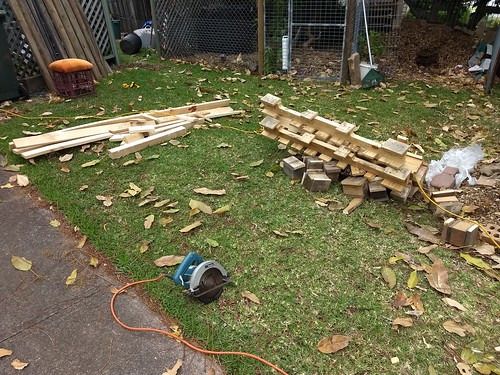
Firstly, there was cutting up the pallets. At one point early on, I nearly cut through the cord - ended up breaking through the plastic part but not actually exposing any of the electrical wire. lucky!

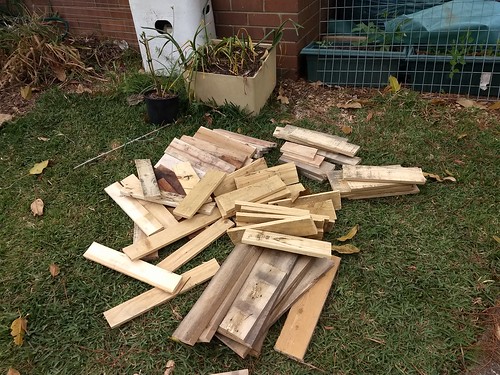
pallet bed frame - offcuts

The pile of wood that we got from five pallets was pretty decent:

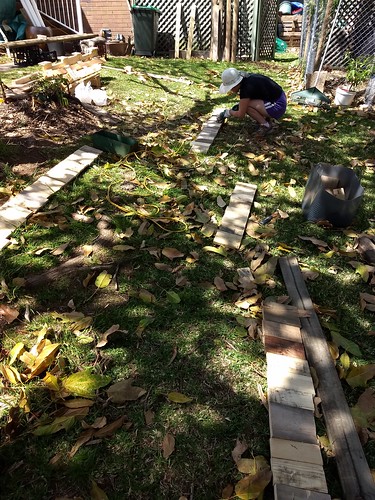
pallet bed frame - sides

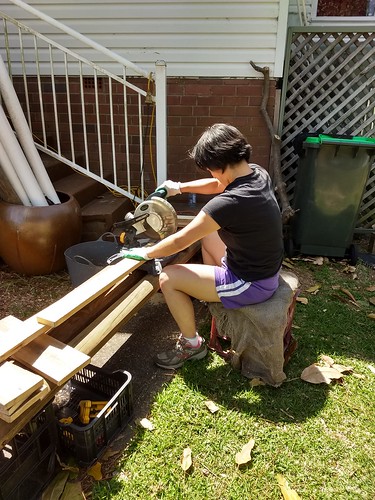
I got practise using the dropsaw:

pallet bed frame - dropsaw

Then there was measuring, nailing the 'palings' to the braces, and connecting the sides.

This is me using an angle-grinder to file off the tips of the nails. The nails I'd bought were a fraction too long, meaning they stuck out of the other side of the wood.

pallet bed frame - finishing

Squaring it up was an absolute nightmare, partly because of the corner posts I chose to use, partly because we were a bit lackadaisical with the measurements. But, after a lot of back and forth on how we were going to do this...success!

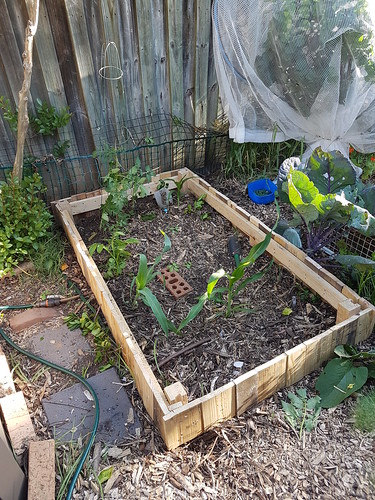
pallet bed frame - finished

And the chook tractor fits nicely on top of it.

pallet bed frame - with tractor

So, that's one - on the Crepe-Apricot bed.

I'd like at least two more - for the Apricot-Avo bed and the Avo-Shed beds. Ideally, I'd like four more - for the two beds previously mentioned, plus the Plum-Stone and Apple-Crepe beds, just so the backyard has a single aesthetic. Anyway, ith the Sydney Edible Garden Trail 2020 coming up, I need to start putting down my design on paper, so there's a better record of how the design has changed over the last five years.

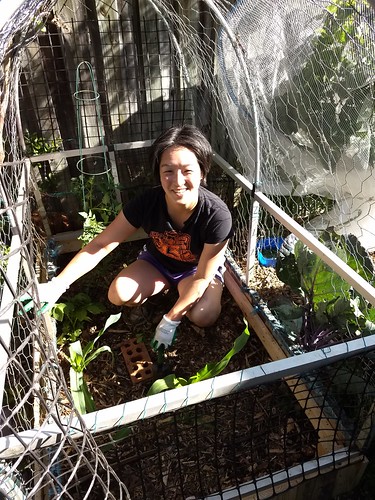
But this is the last photo of the day:

Bed frame

On Monday I'll be planting out the bed, most likely with Jolly Roger corn and...pumpkin? Some kind of melon? More dried beans? I don't even know right now. Have to think about it some more.

18 October, 2019

things to do this spring

1. Fill the beds with so many green growing things that if necessary, I can chop-and-drop some of them when the heat hits.
2. Make frames for the chook stations. (YouTube vid: How to build a pallet bed)
3. Plant out the chook yard with a) one bed of Clucker Tucker, b) things along the fenceline, both inside and out
4. Paint the fence.

11 October, 2019

Spring Update 2019

It is the middle of spring, and everything is growing.

The asparagus are growing nearly as fast as I can eat them:
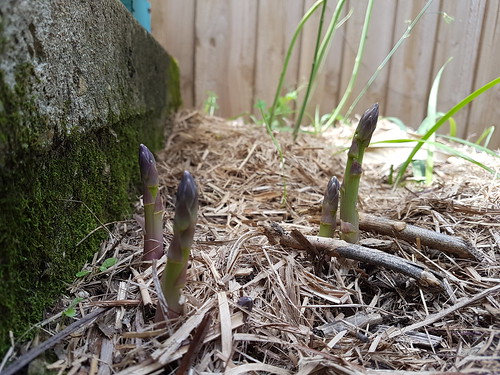
Garden Oct 2019

--

The wicking bed out the side (North-facing) has started kicking in over the last month, with eggplants, onions, tomatoes, and peas. I've succession-planted some beans among the peas, and also a luffa plant - hopefully some of the other vine melon plants sprout and I'll put them in there to act as a shade screen over the heat of the summer.

Garden Oct 2019

--

The Plum-Stone bed has been sitting pretty quiet through the winter - I planted a bunch of broad beans (which mostly have aphids), peas (didn't take very well), sprouting broccoli (mostly went to seed the instant it started warming up), and mustard (the only thing doing well and pest-less in the photo).

Garden Oct 2019

--

The Apple-Crepe bed is a problem. I filled it with a soil that I got as part of a project, but it was extremly alkaline (ph of around 9, when what you want is about 6.5-7 for most vegies) and likely not all that great for growing things in.
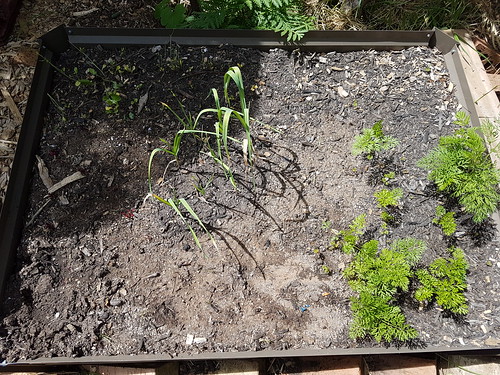
Garden Oct 2019

That's radish in the shade, garlic in the middle of the bed, and carrots in the sun. What you can't see are the onions and leeks, or beetroots, and the parsnips never even materialised. (Parsnips are incredibly difficult to grow apparently: the seed needs to be fresh, and all the conditions need to be right.) This bed was planted back in May, maybe June. And it hasn't grown at all. That's how bad the soil is.

Also, I underfilled the bed with woodchips, thinking they would break down. I kind of doubt that they did, it's probably a mess under there. Anyway, I need to transplant the garlic (I might try to turn it into perennial garlic in the herb bed - just keep trimming the green tops and they grow more green tops - gives the taste of garlic even if it's not the bulb) and pull out all the failed vegies. Kind of heartbreaking though.

--

This is the Crepe-Apricot bed which is going to hold sweet corn this season. It's mostly an 'in progress' pic to show what it looks like now. Hopefully in five months, it will look entirely entirely different!

Garden Oct 2019

Mind you, I planted about a dozen seeds here, straight into the ground, and exactly two of them have grown. I'm better off planting corn in seedling trays and then transplanting, I think. A much better strike rate.

That big green-and-purple thing on the right side of the photo is a...brassica that I planted in winter. I don't know what kind (I'm bad at labelling) but I thought it was a brussels sprout. I suspect it might be a purple sprouting broccoli but it's hard to tell. It's doing better than the other two which I planted under the Stone fruit tree which are...pretty much the same size that they were when I planted them. Maybe marginally bigger. :/

--

The Apricot-Avocado bed had a compost heap on it for about six weeks over winter, before I transferred it to another compost heap and raked it out into the Apricot bed (which I'm trying to grow green manure/meadow flowers on).

Now it has...brassicas. Yes, 'brassicas'. World's Most Terrible Labeller, remember?
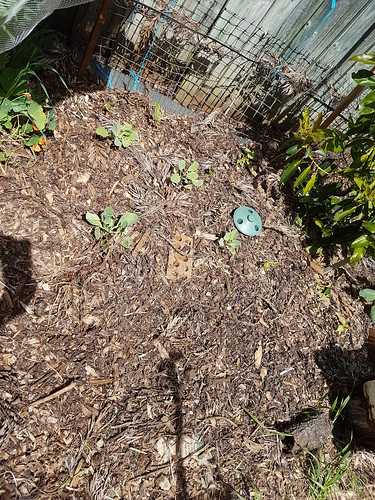
Garden Oct 2019

I guess we'll see if they head or not. Also: it being summer, it's probably going to get too hot for them really fast, so I'm trying to grow things in front of them to take up more sunlight for them as well as to grow things pretty closely so it's a melange of green and growing things that shade the ground and make the evaporation of any watering a little slower. The 'somethings' that I plant will probably be indeterminate tomatoes, because who doesn't love a billion tomatoes come autumn?

There are a couple of beans up the back of the bed; and I've tossed down a bunch of 'green manures' which are quick growing nitrogen fixers that will not only improve the nitrogen in the bed, but also provide some mulching bulk as the summer wears on.

--

And the bed at the end of the line - the Avo-Shed bed - has more brassicas which are probably a mix of cabbages and sprouting broccoli, a tomatillo (or two, I hope, once the thing gets moving) in the front, and a row of beans along the back. Unfortunately, I managed to double-plant beans, because I planted a bunch and then forgot I'd planted them, and then planted another set, and both sets sprouted. *rolls eyes*

Garden Oct 2019

--

Speaking of the chooks, they're spending most of their days out in the front run, are laying, and quite happy to get in yo' face.

what 'choo lookin' at?

Interestingly, there's a section of the chook run which abuts the neighbour's yard beyond the fenceline, and I've noticed the neighbours have started throwing some of their kitchen wastes into the chook pen. Which, they're from out rural way, used to be farm folk, so I understand, so I trust they're not trying to poison my chooks. I've had a bit of a chat to them about the chickens when they first moved in (because I was worried about the noise they might make) but they've been pretty good about the occasional noisy clucking that takes place when one of the chooks wants something and isn;t getting it. (Hainan chicken is particularly noisy when she's bored.)

--

There's still the front yard to go. Maybe talk abotu that some other time...
01 October, 2019

Sydney Edible Garden Trail: my garden

I’ve signed up my garden to go in the Sydney Edible Garden Tour in March, and am starting to think about how I’m going to do this.

Anyway, I’m thinking about the more unique points of my garden and I think the key aspects are:

  • a very small space to grow things in
  • chooks in the garden
  • fruit trees in the garden
  • in-ground wicking beds (note: if they work over summer; these are not yet in place)

Focus Ideas for the Edible Garden Tour in March

  • One Magic Square plots
  • Chooks in the garden
  • Gardening rotations
  • Fruit trees in the garden
  • Signs and videos for more information

Unique Points

  • chooks in the garden
  • fruit trees in the garden
  • composting, worm farms
  • neighbourhood
  • in-ground wicking beds (milk-carton wicking)

Just thoughts at this point, although I've asked the group for the Sydney Edible Garden Trail group on FB for their thoughts.

05 September, 2019

in-ground wicking beds?

The in-ground wicking beds are an idea I’ve had for a while – a way to make wicking beds (with a water reservoir) that don’t require an above-ground bed. This is mostly because I’d already set up my garden beds with the chook run and to change them to significantly above ground isn’t practical at this point in time.

To be effective, wicking beds require:

  • a container under the soil, easily refillable with water, not so easy for the soil to get into (the reservoir)
  • a medium for transferring water to the soil (the wick)

A milk carton beneath the ground, stuffed with geotex then using strips of geotex/cotton fabric to wick water out, would be easily refillable, while still wicking water out to the soil instead of evaporating from the surface. Best of all, you don’t need to completely take apart and reinstall your garden bed, and you could install these in the ground.

It would probably need watering more frequently than your standard wicking bed, but should also be providing water to plants through the harsh heat of summer, only requiring filling every couple of days, and without losing water through evaporation.

Will need:

  • 8x 2L plastic milk bottles
  • the plastic rings from your milk
  • geotextile, cut into 2” strips
  • cotton fabric cut into 2” strips
  • plastic straws(*)

(*) collect used straws for this, they’ll only get thrown out otherwise, and they make excellent visual markers for the location of your water wells

Process
(highly experimental, have not actually tried this yet)

  1. Unscrew the lids off the milk bottles and put the lids (and the plastic rings that fix the lids) aside.
  2. Cut the plastic milk bottles in half.
  3. Dig a hole in the ground half again as deep as the bottom half of the milk bottle, and settle the milk bottle bottom firmly into the hole.
  4. Backfill the hole around the milk bottle until the soil is about 1cm below the lip of the milk bottle.
  5. Cut a rectangle of geotextile 50cm x 30cm. Fringe the geotextile along one side and roll it up.
  6. Stuff the fringed geotextile into the bottom half of the plastic milk bottle with the fringe hanging out the top.
  7. Cut a square of geotextile 15cm x 15cm, lay it over the milk bottle and then fit the top half of the milk bottle over the geotextile and the 'lip' of the bottom half of the milk bottle, so that the bottom half is sitting just inside the top half.
  8. Backfill the hole around the top half of the milk bottle.
  9. Put the milk bottle lid back on the top half of the milk bottle.

My original idea involved poking a straw through the geotex so there was some idea of where the reservoirs are when it comes time to water them. Just water over and around the straw and it would be fine! However, I am presently debating the practicality of this, the risk of soil getting into the reservoir, the difficulty in the water wells displacing the amount of soil needed for growing whatever it is that is being grown in the bed...

I may have to think about it more.

29 August, 2019

last winter tasks

I've sowed seeds and put them in mini greenhouses to grow; the tomatoes (planted in July) are going great guns, haven't seen much of the others yet but they were only planted a week ago so...not surprising.
Garden flowers in August

I really need to set up the proper greenhouse along the back of the carport, but that probably won't happen until at least the end of the month.

Kumquat, Avo, and Lychee are planted. The rose has been trimmed back with the assistance of a neighbour (thanks Bev), and the chooks have been moved to the back yard again.

I grafted a couple of the apple scions on to the multi-apple up the back. We'll see how they do going forward.

There was an exceedingly brief spell of rain yesterday evening (as in, ten minutes, max) and then it was gone.

This week, after work, I'll remove the fencing around the fruit trees in the front, smooth out the ground, fertilise at the dripline, then water the trees and shift around the woodchips for best effect.

Garden flowers in August

I wonder if I could collect water in wall-to-wall buckets in the shower. Could get interesting.

Water management is going to be a big thing going forward. So much of what goes down the drain is lightly soiled at worst - has just run over human skin or washed vegetables clean, and could easily be reused on the garden. Need to call a plumber and talk about how difficult it would be to switch things around. Even using bathroom sink water to fill the toilet cistern.

That's not even counting the water tank that we have. Need a pump. Need to connect it up. Need to work out where the water is going to go on the garden...

I wonder if I could recruit the neighbours for scraps and lawn clippings and chook scraps this summer?

ETA: It’s now a couple of weeks later, and things have shifted – sometimes incrementally, sometimes rather more than that.

All the stonefruit is flowering: peaches, nectarines, plums, apricots. The exception is the cherry, which hasn’t even broken leaves yet. I’m not sure what it’s waiting for.

The multi-stone plum is flowering quite nicely as usual

Garden flowers in August

One of the peaches already has significant-sized fruit on it. I’m going to have to net it this weekend or it’ll end up fruit fly fodder. That’s pretty much the call for this weekend’s work – netting the fruit trees and finishing off the composts. As projects go, they’re pretty big ones.

This is the multi-stone apricot, with teeny tiny fruit:

Garden flowers in August

I have two more bare-root apricot trees. They arrived on Tuesday. *hangdog look* I couldn’t help it! They were on sale! My finger slipped! (They’ll be going into large pots with water wells for moving around the garden.)

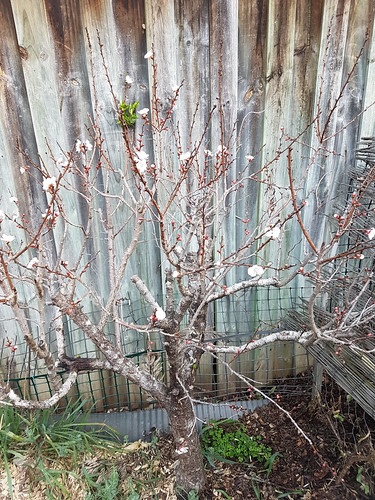
The apricot tree in flower. It has gummosis, which is why I’m not sure it’s going to last very long. But even if it didn’t, I don’t think there can be too many apricots ever.

Garden flowers in August

The broad beans are flowering (going to have to work out how to deal with the inevitable aphids), and the mustard is going pretty well in that bed. Need to start using those leaves instead of letting the bugs eat them.

Nasturtiums everywhere, which I don’t actually mind, they make good groundcover. I need more groundcover and more border plants.

I wonder if I could co-opt church kids to help me build garden beds. (I made a joke of it last night at bible study and some of the parents were ‘you might actually get some interest there’.) Except, you know, safety and stuff. And circular saws and toes. *shudder*

So this weekend the list of potential things to do are:
net fruit trees
building compost
potting bare-root apricot trees
re-potting mango or chocolate pudding tree

Next week (after work), the list of things to do is:
plant out the cabbage-eggplant box
seedbox all the seedlings that are starting to go beserk
set up potato bags (dirt and potatoes in the bottom, add sifted compost on top)

13 August, 2019

how do you like them apples?

Quite a lot, actually!

On Saturday I went to the garden of one of the women at my Permaculture Gardening Group who was going to take us through Pruning, Air-Layering, and Grafting.

Pruning and orchards

The part I was really interested in was the part where she offered scions of her apple trees. She has FOURTEEN kinds of apples in a suburban garden, most of them grafted on individuals trees. It was AMAZING and I came away quite inspired in several dimensions.

Pruning and orchards

I did have about six apple types before I got a bunch of her scions. Four arrived already grafted on a single rootstock: Anna, Granny Smith, Golden Dorset, and a mystery apple (I lost the tag that indicated what type it was, but it might have been a Jonathan?). And two were individual trees from my mother: a Golden Delicious and a Gala.

I got about nine apple scions from her: Akane, Adre Sauvage, Blenheim Oragne, Tropic Sweet, Tropic Dorsett, Tropic Anna, Egremont Russelt, Kid's Orange Red, and Yates.

I have two more apples coming: a Pink Lady with a Braeburn grafted to it. The Braeburn is because my sister loves them, but they don't grow them commercially this far north because the climate doesn't support it - Braeburns are cold-weather trees.

So, yes, we should be covered for apples through the season. Assuming I can get a harvest from them.

And, more importantly, that I can successfully get the grafts to take...

Right now, I'm thinking of which ones I should graft together - cross-pollination requires multiple cultivars flowering around the same time.

Having looked up various apple types, I'm reasonably sure there are maybe 4 pollination groups:
P1: Anna & Golden Dorset
P2: Tropic Sweet, Tropic Dorsett, Tropic Anna, Egremenot Russet.
P3: Akane, Andre Sauvage, Blenheim Orange, Kidd's Orange Red, Yates, Granny Smith, and Golden Delicious, Pink Lady
P4: Gala & Braeburn.

The strikeouts are already on the one tree, along with the mystery apple, which is most likely in a similar pollination group. I could add to the existing multi-apple, I suppose but more than four is probably pushing it, and there are other rootstocks available.

So, probably a mix of P2, P3, and P4 on the Golden Delicious and the Gala and the Pink Lady:
Golden Delicious: Tropic Sweet, Tropic Anna, Blenheim Orange
Gala: Akane, Andre Sauvage, Tropic Dorsett, Yates,
Pink Lady: Braeburn, Gala, Egremont Russet, Kidd's Orange Red

I think some of it will very much depend on what takes. It could be a bit of a hit and miss.

The pruning unit was educational too. I've been pruning my apples like my stone fruit and...that's not the way to do it apparently... But the multi-apple has a few blossoms - at least one of the branches appears to be a tip-bearer rather than a spur-bearer, which might explain why I haven't really had any fruit from it at all! I've been pruning it back and probably pruned off all the fruit-bearing shoots! and then there's nothing left to enable cross-pollination...

Ah well, we garden and learn. I just wish I'd learned a bit earlier.

a bunch of apple-growing links

University of Mass: Spindle Pruning Apple Trees (video)

Fruit Grower’s News: Tall Spindle Design for apples - I’m still trying to find a proper/definitive description of spindle systems and how to prune trees into that shape.

Kimmel Orchard: Tuesdays With Tyler high density orchard plantings - there’s a whole series about orchard care in here.

How to prune apple trees in winter: summer for fruiting and growth, winter for vigour.

I’m also going to need to read up on apricots soon. I’d like one really good harvest out of the backyard apricot before it gives way to probable gummosis. *sadface*