Showing posts with label integrated pest management. Show all posts

15 July, 2023

Diary - 15th July, 2023

WEATHER:

Sunny and dry. Warmer, no bite in the morning - my car said 25C at midday.

RAIN

None for weeks.

CHOOKS:

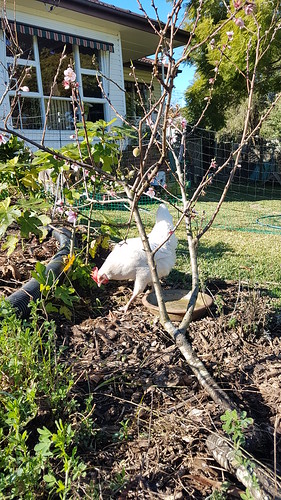
All seem pretty happy and healthy. Goong has a red comb, Siyao's is pretty red, too. Caramabah is still demanding food all the time, and Chouquette isn't showing signs of going into lay. Chouquette comes close and allows me to pet her, but it's more a "where's the food, no food? no pets" kind of attitude.

OBSERVATIONS

Some major cracks in the front yard. Going to contact a plumber about having a look into them with one of those long and flexible cameras. If I can find one to come do the work.

One of the brick pylons under the house is rather less-than-straight. The middle one on the eastern side of B1's bedroom is not perfectly plumb, like it's gently being pushed over. I don't know if it was always like that or has only been in the last couple of years. The problem is that I didn't notice these things before and I'm noticing them now. It's one of the reasons why observation is so important, I guess.

Native bees are back and active on the warmer days. Very still and quiet on the colder ones, and I try to remember to cover them up a little on the cold nights, then open them up so they won't grow mould. But they're active and involved and seem to be doing well.
Permabee and June

The TWO-STONE and DUAL-STONE are in flower. The TROPIC DORSET on the Golden Delicious APPLE is setting buds ready to bloom.

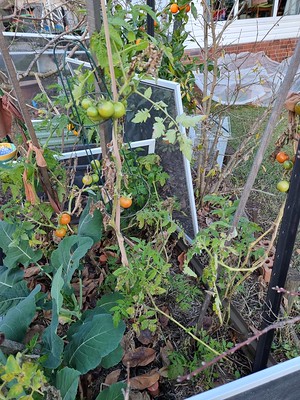
The TOMATOES in the bed under the TWO-STONE tree are generally dying - we had some frost, and although I had the old window screens up to give them a bit of a buffer, the one on the south blew off and I think that the tomatoes that would have been otherwise protected by them are now dying.

PREPARATION:

Green mulch. Need to plant out some green mulch in the summer beds. And I just realised that I prepped some COWPEA mulch for the back beds...and forgot that the stuff is for summer mulch. I guess I can plant it and see what survives, but I don't really like the chances. I should have prepped the Woolly Pod Vetch but that stuff can get weedy really easily and I didn't want to risk it. *sigh* Well, we'll plant the COWPEA and see how it does.

PUMPKIN-POTATO bed should probably be green-mulched.

PLANTING

Today, I planted out four ASPARAGUS ferns into the LOWER STEP BED. I've been trying to grow things in that bed for years and the only thing that really grows there are weeds. But the asparagus grows fine in the upper beds with some fertilising and watering, so I'm doing it. Also put the THYME in there from Wormticklers, and tossed down a lot of MUSTARD. To finish it off, I need to put down the remaining pea-straw from the pack.

I was thinking about fertilising the UPPER STEP BED with matured chook manures collected from the coop back when there were blood mites - I think it was 2021? Going to have to look back at the diary for that. But because I associate this manure with the mites, I'm nervous about putting it on the garden, even though it's a long way from the chooks. Just gotta bite the bullet I guess and do it. Get past the fear, etc.

I also planted PARSNIPS under the apples, both the FOUR-APPLE and the GOLDEN DELICIOUS. Less for the roots themselves, more for the greens and the flowers and the promise of pollinators and pest-control. (If they flower.) Probably should have also done daikon and beetroot, just to break up the soil some.

RIPENING

Still the oranges and I think they're tangerines? The ALPINE STRAWBS have been doing their thing pretty well.

HARVEST

BROCCOLI leaves. I need to remember to cook the BROCCOLI leaves! Occasional TOMATOES from the westernmost bed in the TRIANGLE GARDEN.

PRUNING

Did the RASPBERRY PATCH a couple of weeks ago, trimming most of it down and clipping up most of the canes. I didn't really check for spring/autumn canes, and now I need to toss down a bunch of manure and maybe some hay/mulch to give it some feeding before the spring.

Backyard AVOCADO needs pruning down, snip off the tops of the tree. Needs it soon because it's starting to sprout again and I think the next round of flowers are likely to be coming...

The bush of THAI BASIL and the SALVIAS out the front need serious haircuts and soon. Now's a good time to do it, the flowers on the stone fruit trees and the Golden Dorset branch will keep the bees occupied.

THOUGHTS and PLANS

With the weather looking very fine, I could probably make the wooden seats in the next couple of weekends.

I want to set up potable water collection off the roof - I should probably look into that sustainable house in the inner west, find out what they did and how they did it and whether it's replicable here.

There's a part of me that wants to die very fast and very soon. I'm good for it, no real regrets, no need to live forever. But also, there's a part that would like to see what I've developed here go to someone who wants to use it, not just someone who'd bulldoze the lot and build a McMansion.

16 June, 2023

dear diary: 3rd June - spraying

Sprayed the fruit trees today - Lime Sulphur
Peaches & Stonefruit was 20% solution
Apples was 10% solution
And just for kicks I also did the frangipani (1%) which has rust on its leaves and is probably spreading it everywhere through the garden

Gotta do it again in a week.

Then the week after, the Copper Spray

I think at least one of the trees shouldn't be sprayed with one of the sprays. I think it's the apricots with Copper spray.

Permabee is going ahead - new chicken tunnels! Maybe new garden beds.

19 May, 2023

throwing shade

Back garden is a lot of shady spots.

What do I need for filler? Where do I need it?
- shady spaces, like in the south-east corner (hellebores, coleus, bromeliads, aussie native violet, anemones)
- under the avocado tree where the tomatoes are failing miserably (daffodils for spring? aussie native violets, maybe the kidney-shaped leaves thing)

Planning for climate catastrophe:
- water (want to get a filter for the tank water - filter entry on the tank, filter outlet, too?)
- fire protection: if fire comes to the neighbourhood, how to stop it from spreading?
- petrol runout (bicycles - need to do some work on them)
- electric cooker (induction top?)


May: feed citrus
pruning branches and leaves
spray lime sulphur (1st time)

June: spray lime sulphur (2nd time)

July: spray copper, run chooks in triangle garden

August: grafting, run chooks in triangle garden


Bought 7 african daises, 5 single-petal hellebores, 5 dahlias.

African daisies to go on the far side of the fence; Hellebores to go in the shade space; Dahlias to go in the trimmed-back picket fence garden space.

13 August, 2020

fruit tree FAQ

Garden winter to spring

I often get asked about my fruit trees and what I do to get my trees to produce so abundantly. Rather than answering all the questions individually, I'm just going to make this post and point people towards it in future!

Quickie (if you want the fast and nasty!)

  1. Yes, these fruit rees are grown on my tree in Sydney suburbia.
  2. The trees shown here are mostly around four or five years old; some are older, some are younger. However, I didn't get a crop from any of them until I put them in the ground and started tending them.
  3. I get my trees from Fruit Salad Trees, Daleys, or Diggers Club.
  4. I don't know the varieties, only that they're low-chill stone fruits that they deliberately select and market for the Sydney and north NSW coastal areas.
  5. A lot of the trees shown here are on the north side of the property, right next to a concrete slab that absorbs a lot of sunlight during the day. As a result that section of the garden is warmer and tends to produce fruit earlier than other fruit trees of the same type and kind.

The longer, more in-depth FAQ

Whereabouts are you?

I'm in Sydney - northern Sydney, about 11m above sea level, in foothills. It's Mediterranean in summer, but temperate cool in winter. Specifically I live a little east of the Hills District, and this is important because microclimate matters. We're on a ridge that might get a touch of frost from the south at the height of winter (late July to late August), and which isn't at all insulated from the west winds. West is our primary wind direction all year, with the exception of spring which is when it comes from the northeast.

My property aspect is open to the west and the north, with a great slab of concrete on the north side of the property - the driveway - that absorbs a lot of sunlight during the day and means that side of the property is a number of degrees warmer for longer during the winter. As a result, several of the stone fruit trees on that side of the property start to flower earlier than most trees of the same type and variety and I'm harvesting in October and November while most Sydneysiders are still growing their fruit.

I have a very shaded/protected backyard; it's also quite small. As a result, it's an effort and a half keeping the fruit trees there under control. I have 7 of them growing in a space about 50sqm, with a crepe myrtle, and (unfortunately) a silky oak on the other side the boundary line. (I'm in negotiations with the neighbour to get rid of it.)

In the backyard, the fruiting seasons are variable. The nectarine and donut peach on the stone fruit tree are early - done fruiting by December, but the plum on the same tree is late - February or March, and the independent donut peach is also mid-to-late - Jan or Feb.

Garden winter to spring

Where do you get your trees?

A lot of my trees come from Fruit Salad Trees on the mid-north coast of NSW. They offer low-chill varieties for Sydney, but also offer trees tailored to your area's climate. Those that don't come from Fruit Salad Trees would have come from Daleys, or from Diggers Club.

Garden May 2020 Garden May 2020

What type of fruit and nut trees do you have?

I have: peaches, nectarines, plums, apricots, a cherry, a lemon, a lime, a macadamia, avocados, a pomegranate, grapevines, a persimmon, a fig, an elderberry, a mango, a guava, a black sapote, bananas, a kiwiberry, raspberries, a mulberry, and apples.

That said, half the time I don't know what variety I have on the tree; it's just "white peach, white nectarine" or "white nectarine, yellow peach". I'm bad at varieties, which is something of a problem, because varieties are the spice of life the determining factor in which fruit will do best in your garden.

Most of the pics of peaches and nectarines that I show are from the Fruit Salad company, the exception is the donut peach tree in the backyard. That was a gift from my mother and which has grown significantly in the last five years.

It's worth noting that the land my house is built on was once a stone fruit orchard. Back 100 years, this bit of Sydney suburbia was farmland, and the area back then was good for growing stone fruit. It's still good for growing stone fruit, as evidenced by the proliferation of my stone fruit trees.

Garden winter to spring

How do you fertilise your trees?

For most of my trees, I run the chickens under them. I'll have an entire post up about this at a later point, but the gist is that I use the chickens to not only scratch up any bugs and pest eggs in the ground, but also to provide manures and aeration for the topsoil. I throw in any grass clippings, leaf mulches, woodchips, and vegetable wastes that I have and they form a mulch over the roots of the trees, fertilising them. This can also be achieved by buying manures from garden centres if that's your option; I have household chickens and so I work with those.

Sussie and Tjatse #StayHome March-April

Do you prune and manage your trees?

Yes. Every midwinter I prune the trees to keep them a reasonable size and to encourage them to grow in ways that suit my garden. There are some great pruning videos for all kinds of trees all over the internet, but I go by Margaret Siri's advice (ABC, circa 2010) which I've summarised here for the fruit trees that I have in my garden. I prune to shape the tree and make it neater, as well as allow it productivity.

I try to remember to spray for leaf curl and mildews - I don't always manage it! The trees are big and the work that needs to be done is correspondingly huge, and sometimes this work doesn't get done in the end. That's what happens when you have a large garden and a full time job.

For leaf curl, I use the 'traditional' ones - bordeaux spray, copper spray, lime sulphur. I do it in winter, before budswell so the pollinators have no reason to be out, and I try to make sure that the pollinators have plenty of other, more agreeable places to be - in the perennial basil, for instance!

Minibee.

How do you keep pests off?

I fully net the tree with fruit fly netting. My largest tree is about 4m high, and I need a very large netting to encompass it. I bought the fruit fly netting a few years back from Green Harvest; it was quite pricey, but worth it.

Other pests in the area include: rats, possums, and sulphur-crested cockatoos, all of whom stubbornly refuse to share once they find my crop! They are also kept out with the fruit fly netting, and because it's a really fine netting, then birds and small animals don't get caught in it the way they do with "bird netting" and other larger-gap pest netting.

Nectarines in my garden

Is there an easier way to keep pests off?

Before I did the whole tree, I tried

  • hanging fruit fly traps
  • netting individual fruit clusters and hanging fruit fly traps
  • netting branches of the tree and hanging fruit fly traps
And every time, the fruit flies got through and spoiled the entire harvest. There was no "only 50%" unless it was "oh, you can have 50% of this fruit, but the rest of the peach is riddled with fruit fly larvae".

The first year I put a frame up and netted the whole tree? I got a bumper crop.

So, yeah.

People always want to "nickel-and-dime" pest control. Every time I talk about netting trees, people are like "Wow, what a pest nazi she is!" There are people in permaculture and retrosuburbia communities who get very upset about me 'denying nature its share' by netting the whole tree and excluding pests. However, I tried lesser measures for three years and it didn't work; I got next to nothing from the harvest. So now I fully net the trees and I actively advocate for netting the whole tree when people ask what to do.

'Nature' doesn't share. It produces abundance, but that abundance does not necessarily go to whoever tended it unless they take measures to claim it. Netting the tree is my measure to claim what I have worked towards.

One of the principles of permaculture is "Obtain a yield" - gain something from a season, don't work to no purpose. And so, yes, I go full-bore on netting the tree, and I get a harvest that's the envy of people online and offline. I have bounty that I can share with others - including the animals that I'm denying, if I wish - and it encourages others to work towards abundance, too.

Garden winter to spring

Anything else?

You can drop me a comment or send me a mail and I'll try to answer your questions. But these are the things that I do within my parameters, and they work for me. You'll have to work out what you're willing to do in order to gain a yield from your fruit trees.

The thing is, growing fruit in suburbia can be done - and there's no comparing the taste of shop-bought with the taste of homegrown. I promise, once you grow your own, you'll never look back.

Good luck!

01 April, 2020

Companion planting for winter

ASPARAGUS:

  • winter: parsley, coriander, basil, dill, comfrey.
  • spring: basil, lettuce, spinach for early crop and ground cover while ASPARAGUS is still growing
  • also: strawberries, rhubarb, horseradish

APPLES:

  • winter: garlic
  • spring: marigolds
Thoughts for front apples: marigolds Thoughts for back apples: one type of garlic

APRICOT

  • winter: garlic
  • spring: marigolds
Thoughts for back apricot: other type of garlic

BRASSICAS

  • winter: chamomile, coriander, dill, mint, rosemary and sage, carrot, chives,
  • spring: beans, spinach, cucumber

CARROTS

  • winter: brassicas, onions,
  • spring:

CHERRIES

  • winter: garlic
  • spring: marigolds

POTATOES

  • winter: coriander, beets, garlic, onions,
  • spring: corn, marigolds, peas, celery, bush beans,

PARSNIP

  • winter: green peas, rosemary and sage, lettuce,
  • spring: bush beans, peppers, tomatoes, lettuce,

  • winter:
  • spring:

08 November, 2019

on the dangers of half-assing prevention

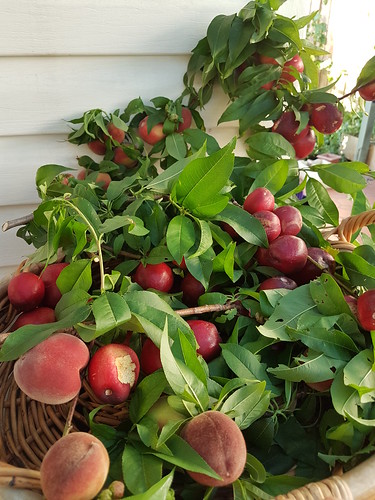
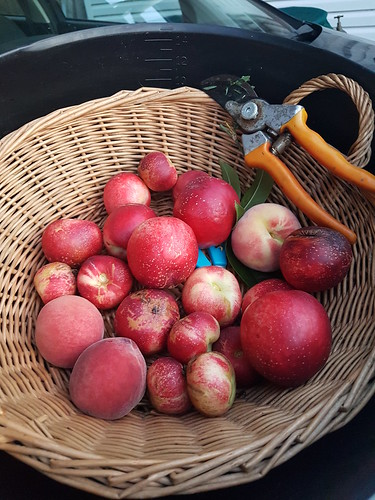
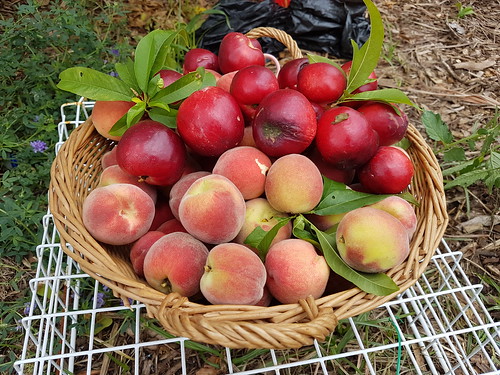
I am swimming in nectarines right now

This is the first day of actual picking of nectarines: the first day...

November 2019

It's so much that I've started out by bottling, to get the biggest and nicest fruit bottled for later:

20191105_142711

People on the gardening groups I'm in keep asking me how I keep fruit fly from my fruit. But when I tell them I net the entire tree, they keep on going back to smaller options.

Can't they put out traps?

Can't they net the individual branches?

Why does it have to be the entire tree? Isn't that a lot of money and effort?

Yes, yes it is. But it's more money and effort to throw out an entire harvest that you've spent 8 months of the year preparing for because the fruit fly got to it. It's the effort and money that you spent for those 8 months of the year, because you couldn't be bothered spending 2 hours setting up a frame for netting to go over the tree.

The first year I didn't net a thing. Everything went to fruit fly. I didn't get a single fruit.

The next year, I set traps - dozens of traps. That didn't work either - again, all fruit was riddled with larvae and inedible.

The next year I netted individual branches. That partially worked - I got about 40% of the harvest.

And then last year, I netted the entire tree.

Nectarines in my garden

100% harvest. Every fruit on that tree was edible. They weren't always pretty and some of them developed mould before I could get around to picking them, but they weren't riddled with fruit fly the way the previous harvests were.

This year, again, I've netted the tree, and it's been ~99% effective. The 1% is because the tree is now too large for the net I had for it last year and there's a small crack in the net. But if I spot the holes, I feed them to the chooks, and the chooks are making short work of them (and they love the fruit flesh).

So when I say to fully net your tree, I'm saying I tried all the other steps and found that only fully netting the tree worked. I tried nickle-and-diming it back in the beginning, but I had to go all-out to successfully get a crop from non-sprayed trees.

Maybe you could get a good crop just by hanging up traps, but I can guarantee you a good crop by fully netting the tree with fruit fly exclusion netting.

Is it pretty? No, it's not.

But is it effective? Absolutely.