05 September, 2019

in-ground wicking beds?

The in-ground wicking beds are an idea I’ve had for a while – a way to make wicking beds (with a water reservoir) that don’t require an above-ground bed. This is mostly because I’d already set up my garden beds with the chook run and to change them to significantly above ground isn’t practical at this point in time.

To be effective, wicking beds require:

  • a container under the soil, easily refillable with water, not so easy for the soil to get into (the reservoir)
  • a medium for transferring water to the soil (the wick)

A milk carton beneath the ground, stuffed with geotex then using strips of geotex/cotton fabric to wick water out, would be easily refillable, while still wicking water out to the soil instead of evaporating from the surface. Best of all, you don’t need to completely take apart and reinstall your garden bed, and you could install these in the ground.

It would probably need watering more frequently than your standard wicking bed, but should also be providing water to plants through the harsh heat of summer, only requiring filling every couple of days, and without losing water through evaporation.

Will need:

  • 8x 2L plastic milk bottles
  • the plastic rings from your milk
  • geotextile, cut into 2” strips
  • cotton fabric cut into 2” strips
  • plastic straws(*)

(*) collect used straws for this, they’ll only get thrown out otherwise, and they make excellent visual markers for the location of your water wells

Process
(highly experimental, have not actually tried this yet)

  1. Unscrew the lids off the milk bottles and put the lids (and the plastic rings that fix the lids) aside.
  2. Cut the plastic milk bottles in half.
  3. Dig a hole in the ground half again as deep as the bottom half of the milk bottle, and settle the milk bottle bottom firmly into the hole.
  4. Backfill the hole around the milk bottle until the soil is about 1cm below the lip of the milk bottle.
  5. Cut a rectangle of geotextile 50cm x 30cm. Fringe the geotextile along one side and roll it up.
  6. Stuff the fringed geotextile into the bottom half of the plastic milk bottle with the fringe hanging out the top.
  7. Cut a square of geotextile 15cm x 15cm, lay it over the milk bottle and then fit the top half of the milk bottle over the geotextile and the 'lip' of the bottom half of the milk bottle, so that the bottom half is sitting just inside the top half.
  8. Backfill the hole around the top half of the milk bottle.
  9. Put the milk bottle lid back on the top half of the milk bottle.

My original idea involved poking a straw through the geotex so there was some idea of where the reservoirs are when it comes time to water them. Just water over and around the straw and it would be fine! However, I am presently debating the practicality of this, the risk of soil getting into the reservoir, the difficulty in the water wells displacing the amount of soil needed for growing whatever it is that is being grown in the bed...

I may have to think about it more.

29 August, 2019

last winter tasks

I've sowed seeds and put them in mini greenhouses to grow; the tomatoes (planted in July) are going great guns, haven't seen much of the others yet but they were only planted a week ago so...not surprising.
Garden flowers in August

I really need to set up the proper greenhouse along the back of the carport, but that probably won't happen until at least the end of the month.

Kumquat, Avo, and Lychee are planted. The rose has been trimmed back with the assistance of a neighbour (thanks Bev), and the chooks have been moved to the back yard again.

I grafted a couple of the apple scions on to the multi-apple up the back. We'll see how they do going forward.

There was an exceedingly brief spell of rain yesterday evening (as in, ten minutes, max) and then it was gone.

This week, after work, I'll remove the fencing around the fruit trees in the front, smooth out the ground, fertilise at the dripline, then water the trees and shift around the woodchips for best effect.

Garden flowers in August

I wonder if I could collect water in wall-to-wall buckets in the shower. Could get interesting.

Water management is going to be a big thing going forward. So much of what goes down the drain is lightly soiled at worst - has just run over human skin or washed vegetables clean, and could easily be reused on the garden. Need to call a plumber and talk about how difficult it would be to switch things around. Even using bathroom sink water to fill the toilet cistern.

That's not even counting the water tank that we have. Need a pump. Need to connect it up. Need to work out where the water is going to go on the garden...

I wonder if I could recruit the neighbours for scraps and lawn clippings and chook scraps this summer?

ETA: It’s now a couple of weeks later, and things have shifted – sometimes incrementally, sometimes rather more than that.

All the stonefruit is flowering: peaches, nectarines, plums, apricots. The exception is the cherry, which hasn’t even broken leaves yet. I’m not sure what it’s waiting for.

The multi-stone plum is flowering quite nicely as usual

Garden flowers in August

One of the peaches already has significant-sized fruit on it. I’m going to have to net it this weekend or it’ll end up fruit fly fodder. That’s pretty much the call for this weekend’s work – netting the fruit trees and finishing off the composts. As projects go, they’re pretty big ones.

This is the multi-stone apricot, with teeny tiny fruit:

Garden flowers in August

I have two more bare-root apricot trees. They arrived on Tuesday. *hangdog look* I couldn’t help it! They were on sale! My finger slipped! (They’ll be going into large pots with water wells for moving around the garden.)

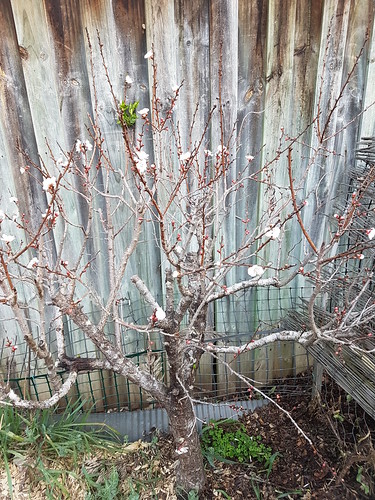
The apricot tree in flower. It has gummosis, which is why I’m not sure it’s going to last very long. But even if it didn’t, I don’t think there can be too many apricots ever.

Garden flowers in August

The broad beans are flowering (going to have to work out how to deal with the inevitable aphids), and the mustard is going pretty well in that bed. Need to start using those leaves instead of letting the bugs eat them.

Nasturtiums everywhere, which I don’t actually mind, they make good groundcover. I need more groundcover and more border plants.

I wonder if I could co-opt church kids to help me build garden beds. (I made a joke of it last night at bible study and some of the parents were ‘you might actually get some interest there’.) Except, you know, safety and stuff. And circular saws and toes. *shudder*

So this weekend the list of potential things to do are:
net fruit trees
building compost
potting bare-root apricot trees
re-potting mango or chocolate pudding tree

Next week (after work), the list of things to do is:
plant out the cabbage-eggplant box
seedbox all the seedlings that are starting to go beserk
set up potato bags (dirt and potatoes in the bottom, add sifted compost on top)

13 August, 2019

how do you like them apples?

Quite a lot, actually!

On Saturday I went to the garden of one of the women at my Permaculture Gardening Group who was going to take us through Pruning, Air-Layering, and Grafting.

Pruning and orchards

The part I was really interested in was the part where she offered scions of her apple trees. She has FOURTEEN kinds of apples in a suburban garden, most of them grafted on individuals trees. It was AMAZING and I came away quite inspired in several dimensions.

Pruning and orchards

I did have about six apple types before I got a bunch of her scions. Four arrived already grafted on a single rootstock: Anna, Granny Smith, Golden Dorset, and a mystery apple (I lost the tag that indicated what type it was, but it might have been a Jonathan?). And two were individual trees from my mother: a Golden Delicious and a Gala.

I got about nine apple scions from her: Akane, Adre Sauvage, Blenheim Oragne, Tropic Sweet, Tropic Dorsett, Tropic Anna, Egremont Russelt, Kid's Orange Red, and Yates.

I have two more apples coming: a Pink Lady with a Braeburn grafted to it. The Braeburn is because my sister loves them, but they don't grow them commercially this far north because the climate doesn't support it - Braeburns are cold-weather trees.

So, yes, we should be covered for apples through the season. Assuming I can get a harvest from them.

And, more importantly, that I can successfully get the grafts to take...

Right now, I'm thinking of which ones I should graft together - cross-pollination requires multiple cultivars flowering around the same time.

Having looked up various apple types, I'm reasonably sure there are maybe 4 pollination groups:
P1: Anna & Golden Dorset
P2: Tropic Sweet, Tropic Dorsett, Tropic Anna, Egremenot Russet.
P3: Akane, Andre Sauvage, Blenheim Orange, Kidd's Orange Red, Yates, Granny Smith, and Golden Delicious, Pink Lady
P4: Gala & Braeburn.

The strikeouts are already on the one tree, along with the mystery apple, which is most likely in a similar pollination group. I could add to the existing multi-apple, I suppose but more than four is probably pushing it, and there are other rootstocks available.

So, probably a mix of P2, P3, and P4 on the Golden Delicious and the Gala and the Pink Lady:
Golden Delicious: Tropic Sweet, Tropic Anna, Blenheim Orange
Gala: Akane, Andre Sauvage, Tropic Dorsett, Yates,
Pink Lady: Braeburn, Gala, Egremont Russet, Kidd's Orange Red

I think some of it will very much depend on what takes. It could be a bit of a hit and miss.

The pruning unit was educational too. I've been pruning my apples like my stone fruit and...that's not the way to do it apparently... But the multi-apple has a few blossoms - at least one of the branches appears to be a tip-bearer rather than a spur-bearer, which might explain why I haven't really had any fruit from it at all! I've been pruning it back and probably pruned off all the fruit-bearing shoots! and then there's nothing left to enable cross-pollination...

Ah well, we garden and learn. I just wish I'd learned a bit earlier.

a bunch of apple-growing links

University of Mass: Spindle Pruning Apple Trees (video)

Fruit Grower’s News: Tall Spindle Design for apples - I’m still trying to find a proper/definitive description of spindle systems and how to prune trees into that shape.

Kimmel Orchard: Tuesdays With Tyler high density orchard plantings - there’s a whole series about orchard care in here.

How to prune apple trees in winter: summer for fruiting and growth, winter for vigour.

I’m also going to need to read up on apricots soon. I’d like one really good harvest out of the backyard apricot before it gives way to probable gummosis. *sadface*

02 August, 2019

climate change and them apples

An interesting read about backyard fruit by Australian gardener Jackie French: how not to grow backyard fruit. Basically, climate change is wrecking the way that gardens seasonally work – as proven by her garden in 2019. Still productive, just not as much as usual.

Mind you, she lives south of me, in the Araluen Valley which is southern NSW and inland a little, where the soil is LEGENDARY fertile and the winters are much sharper than up here in Sydney. The summers are also less humid, and possibly not as hot. So she does a lot more pears and apples than we can do up here, where a more mediterranean climate calls for citrus, and sub-tropicals.

Weirdly, the last season worked beautifully for all my early-flowering stone fruit in Sydney. If we get the same rains in late September and early October, then my nectarines and peaches crop should be pretty spectacular, even though I trimmed all those trees down quite significantly this autumn.

I definitely need to manure the three apples and the dual plum – this weekend, I think. Maybe the cherries, too? I think last season’s dearth of crop was due to wrong weather conditions rather than a lack of nutrients but I’m not entirely sure about that. Hm. Definitely potassium for the cherries and plum, then manure on top – although debating whether to run it through the chook pen first.

1. scrape back woodchips (maybe chip them more finely into a bucket)
2. apply potassium
3. apply manures
4. reapply woodchips

I wonder if the south-west corner of the property would do okay for the apple tree I’ll get in September. Ground is probably rock hard there, but maybe if I wet it down, then manured it, then mulched it, then woodchipped it... It probably still wouldn’t be ready by the time the apple turned up (mid september) but... The main problem would be whether the apple would then be too sheltered by the giant Illawarra Flame. It’ll be a Pink Lady with a Braeburn graft – the Braeburn is the one that we really want, and the issue of the Braeburn’s fruitfulness is primarily to do with chill hours...

I’m wondering if the ridge of green lawn that marched along the run of the sewerage pipe is because the old (probably clay) pipe held some residual moisture in the midst of a drought season that kept that line of grass verdant when the grasses around it faded. Also wondering just how difficult it would be to rig a greywater pipe from the kitchen sink out to the fruit tree garden. Because there’s so much rinsing-off water that just goes down the drain to the sewers and it could be used just as well to water the fruit trees through the dry spells...

Still need to speak with a plumber about the runoff from the roof. And possibly a roofer about the gutters and eaves.

29 July, 2019

Permabee: what happened next

It was a much smaller permabee than the one in December – only 7 people including me. Thankfully, Margaret of Moss House brought her partner Kris along to help and he provided plenty of muscle and practicality.

We moved the water tank, remade the compost bioreactor (chopping up the smaller pieces in the process), and planted out the front treefence.

I dithered a lot. Particularly in the planting of the treefence, but it’s done now. From the north, going south:

  • seed avocado (already planted)
  • kaffir lime
  • elder tree
  • macadamia
  • lemon tree

Having discussed the removal of the jacaranda with my sister, we discovered that Margaret’s husband loves both climbing (with ropes and harnesses) and tree lopping. He’s willing to do it ‘just for fun’. That’s $1K saved! Now just have to deal with the council on the issue of the jacaranda.

I’m thinking we might do the food forest around the Flame Tree. The chiefest problem is that all the trees that we have left are evergreens: black sapote (chocolate pudding), kumquat, mango, lychee, etc. And they’ll block out the light under the tree in the middle of summer which is not the best outcome.

Perhaps the kumquat could go at the lounge corner of the house, while the lychee is at the lounge-porch corner, add the acerola cherry in as a low hedge/bush to shade the brick wall… That leaves the mango, banana circle, paw paws, pineapples, 1x avocado, and chocolate pudding tree for where the jacaranda presently is, once it’s been cut down. That should get sun all year around. Water may be a problem but isn’t it always? I can probably run a bucket greywater line out that way eventually.

The mulberry and 1x avocado at the gate corner would also work nicely: they won’t be blocking anything but each other, and the mulberry should provide the avo with some shade/protection, so long as I keep it trimmed down. Maybe?

Temporary plantings along front bed (one season)

  • sunflowers
  • marigolds
  • poppies/poppy mixes (rake away mulch, bare a line of soil, moisten soil, sow seeds, moisten with soil)
  • eggplant
  • tomatoes
  • broccoli

Plant (perennials, longer term)

  • comfrey & borage
  • lawn thyme (dig out around the water tap and plant the thyme)
  • oregano
  • rosemary bush
  • lavendar
  • parsley
  • allium flower bulbs (not sure if annual or perennial)
  • lemongrass
  • rhubarb crowns (need to acquire first)
  • vietnamese mint

Good planting days for August are listed here and I still have to think about what to companion plant with the apricot. I have asparagus which aren’t performing fantastically where they are – decent, but not amazing – but sometimes I feel like that’s the story of my garden…

22 July, 2019

Permabee plans (iteration 1)

Move water tank
a. prereq: chop down bush
b. prereq: set down frame to hold gravel (sleepers)
c. prereq: gravel into frame
d. buy: short metal stakes for framework, ~1m cube gravel

undo biocompost & remake
a. empty biocompost
b. reset frame
c. chip the chips to make them smaller
d. remake biocompost
e. get: coffee grounds, horse manures, grass clippings from neighbours, café wastes; mix it all in. (ask for: comfrey and other micronutrient plants)

plan(t) out front food forest/fence
a. macadamias and acerola cherry
b. elder | loquat | mulberry | black sapote | avocado
c. citruses (? bad time in winter – leave until Oct-Nov and plant down at the edges of flame tree once jacaranda is gone?)
d. underplanting with borage, vietnamese basil, comfrey, sprinkle with floral seeds in between

plan(t) out banana circle
a. not actually a circle, but certainly a grouping:
b. bananas, mango, pawpaw, black sapote, lychee, avocade
c. ginger, galangal, turmeric,

08 July, 2019

maps and plans

A layout for the garden before I had chickens:

Garden winter 2019

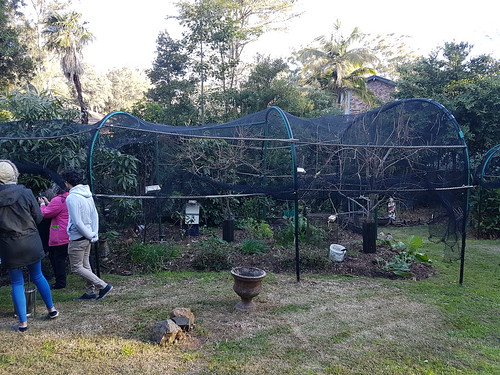
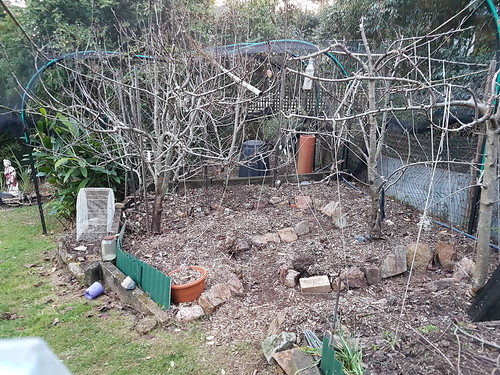
And the garden on the weekend. Easier to see because it's winter and there are no leaves.

Garden winter 2019

Useful to see, isn't it?